


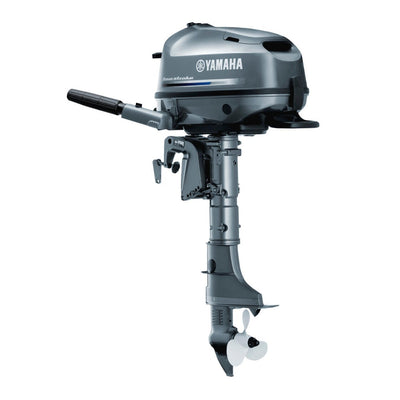
Yamaha 9.9 Outboard Motor
Product Code: YAMF9.9JMHS
The Yamaha 9.9 outboard motor delivers reliable performance for small to medium-sized boats. This lightweight, fuel-efficient engine features Yamaha's proven engineering and smooth operation, making it ideal for fishing, recreational boating, and water sports. With easy starting and minimal maintenance requirements, it provides dependable power for both freshwater and saltwater applications. Built to last with quality construction, this outboard offers excellent value for boat owners seeking a trusted, versatile propulsion solution.
|
Engine type |
SOHC, In-line 2 cylinders |
|
Displacement |
212 cm³ |
|
Bore x stroke |
56.0 × 43.0 mm |
|
Compression ratio |
9.4 : 1 |
|
Fuel induction system |
1 carburetor |
|
Lubrication system |
Wet sump |
|
Engine oil capacity |
0.8 L |
|
Ignition / advance system |
CDI |
|
Alternator |
6 A |
|
Overall length |
MH: 983 mm, E: 557 mm |
|
Overall width |
MH: 357 mm, E: 333 mm |
|
Overall height |
S: 1008 mm, L: 1135 mm |
|
Engine transom height |
S: 431 mm, L: 558 mm |
|
Steering angle |
43 degrees each direction |
|
Dry weight |
40 kg - 45 kg |
|
Maximum propeller shaft output |
7.3 kW |
|
Full throttle operating range |
5000 – 6000 r/min |
|
Idling speed |
1000 – 1100 r/min |
|
Shallow water drive |
Manual: 2 positions |
|
Gear shift |
F-N-R |
|
Gear ratio |
2.08 (27/13) |
|
Gear oil capacity |
0.150 L |
What this engine does - and what it does not
Everything below is from Yamaha's own European technical guide, linked at the foot of this page. What the engine will not do is set out just as plainly as what it will - including one thing that catches people out.
Included
- ✓The most powerful engine you can still call portable7.3 kW from a 212 cm3 twin at 40 to 45 kg. Above this the 15 jumps to 51 to 61 kg and stops being something two people can manage off the transom.
- ✓A twin, not a singleTwo cylinders and 9.4:1 compression. Noticeably smoother at cruising revs than the 139 cm3 singles lower down the range.
- ✓A proper reverse gearF-N-R, with a shallow water drive giving two positions for thin water and four trim positions.
- ✓Short or long shaft431 mm and 558 mm transom heights - the usual 15 in and 20 in, exactly 127 mm apart. Measure before you order.
- ✓Four-stroke, so no mixingNeat unleaded, RON 90, oil in the sump. 0.8 L of engine oil.
Not supported
- ✗The tiller version does not chargeYamaha publishes the alternator on the F9.9J as 6 A except on MH, and MH - manual start, tiller handle - is the version we stock. So this engine has no alternator. If you need charging, the 8 hp has 6 A as standard. Worth reading twice, because it is the opposite of what most listings for this engine imply.
- ✗It shares its block with the 8Same 212 cm3 twin, same 56.0 x 43.0 mm bore and stroke, same compression. Yamaha rates them at 5.9 and 7.3 kW. You are buying tune, not a bigger engine - and here that tune costs you the alternator.
- ✗Two people to move it40 to 45 kg depending on shaft. It bolts to the transom and stays there.
- ✗Manual start and tiller onlyPull start and a tiller handle. The electric-start and remote-control versions are different model codes we do not stock.
- ✗One carburettor, not injectionOnly the 25 hp in this range is fuel injected. Good fuel over winter and the choke on a cold morning.
What you get
The top of the 212 cm3 twin
7.3 kW against the 8 hp's 5.9, from the same block at the same size. The most output before the range steps up in weight.
Two cylinders
Smoother at cruising revs than the singles below it, which is what you feel on a long run rather than a short hop.
Shallow water drive
Two positions to lift the leg in thin water, plus four trim positions to get the boat sitting flat.
Short or long shaft
431 mm or 558 mm transom height - 15 in and 20 in, exactly five inches apart. Measure from the top of the transom to the bottom of the hull.
Reading a Yamaha model code
Yamaha's codes are on every listing, invoice and dealer site, and nothing on the engine explains them. Take F9.9JMHS - once you can read it, the whole range makes sense in about ten seconds.
F9.9 - four-stroke, 9.9 hp
F is the four-stroke family, and the number is the horsepower at the propeller shaft. Every engine in this range is a four-stroke, so every code starts with F.
J - design revision
A letter marking which generation of that model it is. It moves on when Yamaha revises the engine, so it is how you tell a current unit from a superseded one: F9.9J is the current 9.9.
MH - manual start, tiller handle
M is manual pull start, H is a tiller handle. An E in place of the M is electric start, and a code without the H is built for remote controls rather than a tiller.
S - short shaft
S is the short shaft, L the long. On this range the two are exactly 127 mm apart - five inches - which is where the 15 in and 20 in descriptions come from.
How much engine do you actually need?
Horsepower is the number everyone looks at and rarely the one that decides it. Weight, shaft length and whether the engine has a reverse gear matter more on a small boat.
2.5 to 6 hp
A tender, a small dinghy, a yacht's shore boat. Light enough for one person to carry down a pontoon and lift onto a transom. The 4, 5 and 6 are the same 139 cc engine at three states of tune.
8 and 9.9 hp
A bigger tender, a small day boat, or a yacht that wants to push against a foul tide. Both are the same 212 cc twin - the 9.9 is the same engine tuned harder.
15 and 25 hp
Enough to get a small boat planing rather than pushing water. This is transom-bracket and two-people territory, not something you lift off at the end of the day.
Measure the transom
Short shaft suits a transom around 15 in, long shaft around 20 in. Yamaha's own figures put S and L exactly 127 mm apart on every model in this range. Too short and the propeller ventilates in a chop; too long and you drag the leg.
F9.9
Every figure below comes from Yamaha's own European technical guide for the F9.9J, for the MH tiller-handle version we stock.
| Yamaha model code | F9.9JMH |
|---|---|
| Engine type | SOHC, in-line 2 cylinder |
| Displacement | 212 cm3 |
| Bore x stroke | 56.0 x 43.0 mm |
| Compression ratio | 9.4 :1 |
| Fuel induction | 1 carburettor |
| Maximum output at the propeller shaft | 7.3 kW (9.9 ps) |
| Full throttle operating range | 5000 to 6000 r/min |
| Idling speed | 1000 to 1100 r/min |
| Lubrication | Wet sump |
| Ignition | CDI |
| Alternator | Not fitted on the MH tiller version |
| Starting | Manual |
| Control | Tiller handle |
| Gear shift | F-N-R |
| Gear ratio | 2.08 (27/13) |
| Shallow water drive | Manual, 2 positions |
| Trim | 4 positions |
| Transom height | S 431 mm, L 558 mm |
| Dry weight | 40 to 45 kg |
| Engine oil capacity | 0.8 L |
| Gear oil capacity | 0.150 L |
| Recommended fuel | Unleaded regular, RON 90 |
Fitting it
- Match the shaft length to the transom before anything else - S for around 15 in, L for around 20 in.
- Check the boat's maximum power plate. That figure is the ceiling, whatever the transom will physically carry.
- Unleaded regular, RON 90. Fuel goes in neat - the oil lives in the sump.
- Rinse through with fresh water after salt, and stow the engine upright so the leg drains.
- On a small tender, fit a safety lanyard and use it. It is the one piece of kit that only matters once.
Every Yamaha outboard we stock
Live prices and the figures Yamaha publishes in their own European technical guide. Every column links to that guide.
| Model | F2.5 2.5 hp | F4 4 hp | F5 5 hp | F6 6 hp | F8 8 hp | F9.9 9.9 hp | F15 15 hp | F25 25 hp |
|---|---|---|---|---|---|---|---|---|
| You are viewing | ||||||||
| Model code | F2.5BMH | F4BMH | F5AMH | F6CMH | F8FMH | F9.9JMH | F15CMH | F25GMH |
| Engine | OHV, 1 cylinder | OHV, 1 cylinder | OHV, 1 cylinder | OHV, 1 cylinder | SOHC, in-line 2 | SOHC, in-line 2 | SOHC, in-line 2 | SOHC, in-line 2 |
| Displacement | 72 cm3 | 139 cm3 | 139 cm3 | 139 cm3 | 212 cm3 | 212 cm3 | 362 cm3 | 432 cm3 |
| Max output | 1.8 kW (2.5 ps) | 2.9 kW (4 ps) | 3.7 kW (5 ps) | 4.4 kW (6 ps) | 5.9 kW (8 ps) | 7.3 kW (9.9 ps) | 11.0 kW (15 ps) | 18.4 kW (25 ps) |
| Full throttle range | 5250-5750 r/min | 4000-5000 r/min | 4500-5500 r/min | 4500-5500 r/min | 5000-6000 r/min | 5000-6000 r/min | 5000-6000 r/min | 5000-6000 r/min |
| Compression | 8.8 :1 | 8.9 :1 | 8.9 :1 | 8.9 :1 | 9.4 :1 | 9.4 :1 | 9.3 :1 | 9.1 :1 |
| Ignition | TCI | CDI | CDI | CDI | CDI | CDI | CDI | TCI |
| Alternator | None | 6 A optional | 6 A optional | 6 A optional | 6 A | None on MH | None on MH | 16 A |
| Gear shift | F-N only | F-N-R | F-N-R | F-N-R | F-N-R | F-N-R | F-N-R | F-N-R |
| Gear ratio | 2.08 (27/13) | 2.08 (27/13) | 2.08 (27/13) | 2.08 (27/13) | 2.08 (27/13) | 2.08 (27/13) | 2.08 (27/13) | 2.08 (27/13) |
| Shallow water drive | None | 3 positions | 3 positions | 3 positions | Manual, 2 positions | Manual, 2 positions | Manual, 2 positions | Manual, 2 positions |
| Trim | 4 positions | 5 positions | 5 positions | 5 positions | 4 positions | 4 positions | 4 positions | Manual, 4 positions |
| Transom height | S 433 mm / L 560 mm | S 435 mm / L 562 mm | S 435 mm / L 562 mm | S 435 mm / L 562 mm | S 431 mm / L 558 mm | S 431 mm / L 558 mm | S 438 mm / L 565 mm | S 424 mm / L 551 mm |
| Dry weight | 17, 18 kg | 27, 28 kg | 27, 28 kg | 27, 28 kg | 40-43 kg | 40-45 kg | 51-61 kg | 56-70 kg |
| Engine oil | 0.25 L | 0.6 L | 0.6 L | 0.6 L | 0.8 L | 0.8 L | 1.8 L with filter change | 1.1 L with filter change |
| Gear oil | 0.075 L | 0.100 L | 0.100 L | 0.100 L | 0.150 L | 0.150 L | 0.250 L | 0.370 L |
| Price | £739.95 £805 | £1,035 £1,220 | £1,110 £1,310 | £1,310 £1,460 | £1,925 £2,270 | £2,220.64 £2,825 | £2,320 £2,730 | £3,561 £4,190 |
| Yamaha specification | ||||||||
| View product | F2.5 | F4 | F5 | F6 | F8 | You are here | F15 | F25 |
Choosing an outboard
Three questions settle it, and only one of them is about horsepower.
What is the boat rated for?
Most boats carry a plate stating a maximum engine power and often a maximum weight on the transom. That is the ceiling. Fitting more than the plate allows affects handling and, on an inflatable, can lift the bow in a way that is genuinely dangerous.
If there is no plate, tell us the make, length and construction and we will work it out with you.
Short shaft or long?
Measure from the top of the transom straight down to the bottom of the hull. Around 15 in wants a short shaft, around 20 in a long one. Get it wrong and the engine either ventilates when the boat pitches or drags its leg through the water all day.
This is the single most common ordering mistake, and it is not something you can adjust out afterwards.
How often will you lift it?
An engine that lives on the transom can be as heavy as the boat allows. One that gets carried down a pontoon, lifted into a car boot or stowed in a locker has a practical limit well below the legal one - 17 kg is a different proposition from 45 kg every weekend.
Be honest about this. It is the reason people end up not using a perfectly good engine.
What you will also want
You may also need
Worth adding to your order
Yamaha outboard FAQs
Will it charge a battery?
What is the difference between the 8 and the 9.9?
Which shaft length do I need?
Which shaft length do I need?
Will it fit my boat?
What fuel does it take?
It is a four-stroke - do I mix oil with the fuel?
Can I use it in salt water?
How long will it take to arrive?
Not sure which one?
Tell us the boat, the transom height and how often you will be lifting the engine, and we will tell you which Yamaha to buy - including when the smaller one is the right answer.
Talk to the chandlery
 Only 2 left
 Only 2 left
 Only 1 left
Delivery & Returns
We ship chandlery, clothing and marine equipment around the world and always endeavour to get your products to you as quickly and as cost-effectively as possible. We will dispatch your order as soon as possible, usually the day it is received for orders placed before 2PM. Our stock is controlled such that all items bought online are available in stock with our shop or supplier. If there is any delay due to a product being out of stock, or there is a longer lead time, for example, in the case of ‘Special Order’ items, or having a longer lead time for production, we will contact you, however, this will also be suggested at the checkout. In such cases, we will advise when the product will be delivered (or is available for collection if you have opted to collect from our store).
FREE Standard UK Mainland Shipping 1 -2 Working Days - Orders Over £150 - (Excluding Weekends & Bank Hollidays)
Standard UK Mainland 1 - 2 Working Days (Excluding Weekends & Bank Hollidays) - £5.95
Next Day Delivery (Please note that orders must be received by 1400hrs for next day delivery. In some instances, we may be able to dispatch later in the day for next day delivery but this cannot be guaranteed. - £6.95
Scotish Highlands & Islands 2 - 3 Working Days (Excluding Weekends & Bank Hollidays) - 14.45
Isle of Wight 2 - 3 Working Days (Excluding Weekends & Bank Holidays) - £9.45
Northern Ireland 2 - 3 Working Days (Excluding Weekends & Bank Holidays) - £14.95
Our policy is simple – you have up to 90 days to return your purchase if it’s not suitable or you’ve changed your mind. Our hassle-free 90-day returns policy applies to most items and is offered in addition to your statutory rights.
Return goods purchased in-store
Simply bring your order confirmation or delivery note and the item you wish to return or exchange, unused and in its original packaging, to our till point in the shop. If you paid by debit or credit card, please ensure you also bring the payment card you originally used to buy the item/s.
Return goods bought online
1. Start your return through the Returns Process in your Fox’s Chandlery online customer account within 90 days of delivery.
2. Once approved, you will receive a Return Authorisation Number (RAN) and shipping instructions.
3. Package the item securely in its original packaging – please do not apply labels or tape directly to the product packaging.
4. Use a tracked courier service and always obtain proof of postage.
5. Please allow up to 14 working days after we receive the goods for your return to be processed.
If you need your item/s to be collected because it's large or heavy please call our online team on +44 (0) 1473 694725.
If you need to add or remove items from your order, change the details of your delivery address or cancel the order completely, please contact our Online Team for advice on +44 (0) 1473 694725 between 0900 and 1730 Monday to Friday or email us. Please quote your order number and order date. If your order has already been dispatched or delivered, then you will need to follow our Returns procedure in the event of any unwanted products.